One of the most common things I hear during home safety evaluations is:
"We remodeled the bathroom and replaced the bathtub with a walk-in shower so it would be safer."
While a shower stall may look safer, the reality is often more complicated.
Many people assume that removing a bathtub automatically reduces fall risk because there is no longer a large tub wall to step over. However, for individuals recovering from surgery, healing from an injury, experiencing weakness, or living with a neurological condition, the challenge is often not the height of the barrier—it's the act of stepping in and out at all.
To enter a shower stall, a person must typically stand on one leg while advancing the other leg over the shower lip. Even if the shower threshold is only an inch high, this movement requires balance, strength, coordination, and confidence.
The same principle applies when stepping over a bathtub wall.
For someone who is non-weight-bearing, recovering from a hip or knee replacement, experiencing weakness after a stroke, or struggling with balance, standing on one leg can significantly increase fall risk.
A Safer Alternative: The Tub Transfer Bench
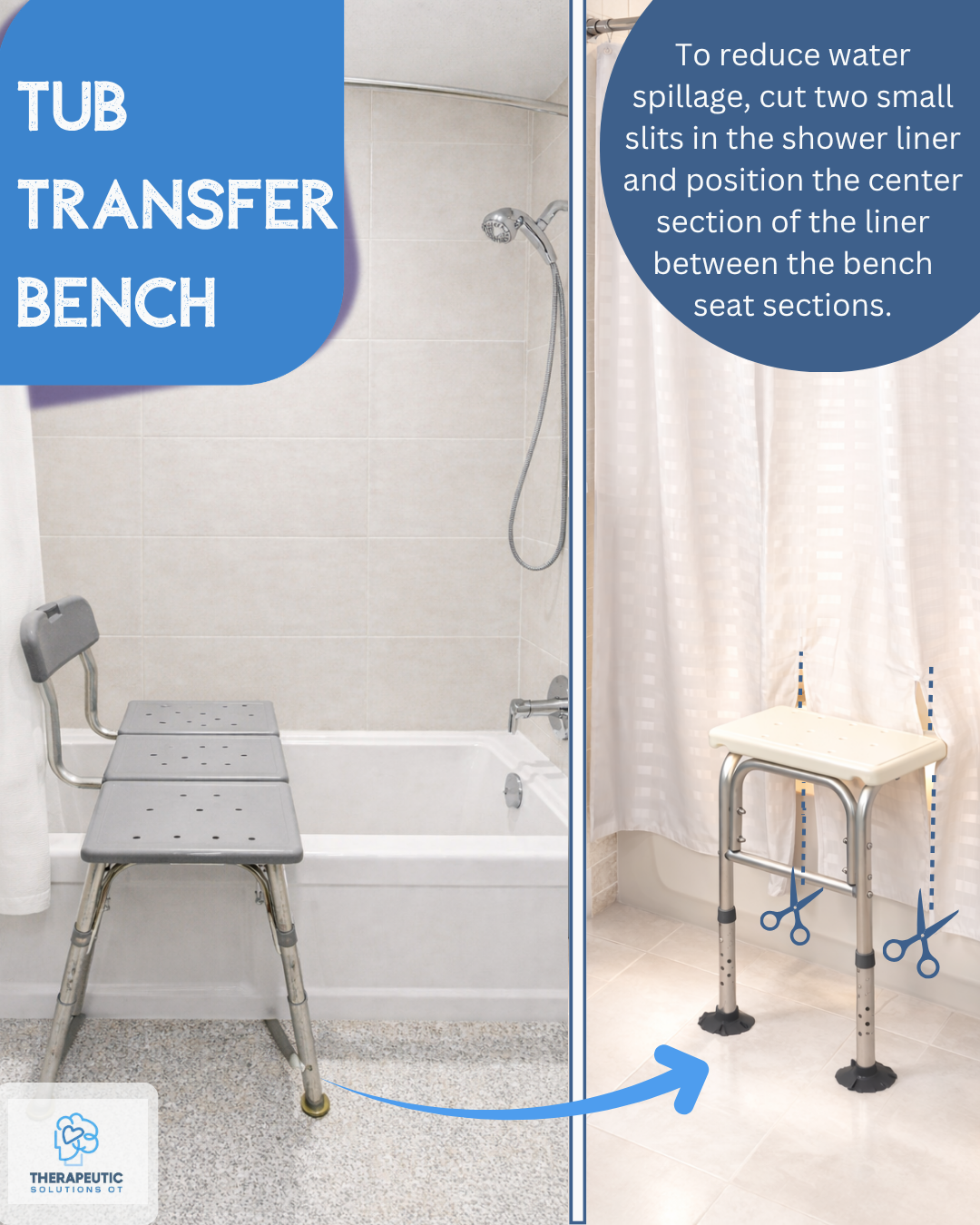
One of the safest recommendations I frequently make is the use of a tub transfer bench.
A tub transfer bench allows a person to sit down outside the tub or shower first and then slide across the bench into the bathing area. Rather than balancing on one leg, hopping, or risking a loss of balance, both legs can be moved safely while remaining seated.
Benefits of a tub transfer bench include:
Reduced fall risk during bathroom transfers
Improved safety after surgery or injury
Easier compliance with weight-bearing precautions
Increased independence during bathing
Greater confidence for both clients and caregivers
The Importance of Consulting an Occupational Therapist Before Remodeling
Bathroom renovations can be expensive, and unfortunately many safety decisions are made without considering how a person actually moves.
An occupational therapist evaluates not only the environment, but also the individual's strength, balance, mobility, and daily routines. In many cases, a relatively simple piece of equipment can provide greater safety than a costly renovation.
Before investing thousands of dollars in a bathroom remodel, consider consulting an occupational therapist. The safest solution is not always the most obvious one—and sometimes the best modification is one that allows you to stay seated rather than requiring you to step over anything at all.